An ACL injury can feel like a major setback, especially for someone who is active and used to moving with confidence. It may happen during football, badminton, gym training, a sudden twist while running, or even an awkward step during an everyday activity. At that moment, the knee may buckle, swell, and immediately feel unstable.
For many patients, the real anxiety begins after the diagnosis. They want to know whether surgery is truly needed, what the operation involves, how long recovery takes, and whether they will be able to return to sports or normal day-to-day movement without fear.
These concerns are completely understandable. ACL reconstruction is a commonly performed procedure, but for someone hearing about it for the first time, it can sound technical and overwhelming. The good news is that with proper diagnosis, the right treatment plan, and a committed rehabilitation programme, many patients are able to regain knee stability and return to an active lifestyle.
This guide explains ACL surgery in simple language, including what the ACL does, how it gets injured, when surgery is considered, what happens during the procedure, and what recovery usually looks like.
What Is the ACL and Why Is It Important?
The ACL, or anterior cruciate ligament, is one of the key ligaments inside the knee joint. It connects the thigh bone to the shin bone and helps control knee stability, particularly during turning, pivoting, landing, and sudden changes in direction.
You can think of it as one of the structures that helps the knee feel secure during movement. When the ACL tears, the knee may no longer feel dependable, especially during sports or activities that involve quick changes in direction.
Some patients describe this as the knee giving way. Others say it feels loose, shaky, or unreliable. Even if day-to-day walking improves after the initial swelling settles, the sense of instability can remain during more demanding activity.
That is why an ACL tear is not just about pain in the moment of injury. It is also about how the knee functions afterwards.
This is when consulting a sports injury specialist in Mumbai becomes important for proper evaluation.
How Does an ACL Injury Usually Happen?
ACL injuries often happen during sudden movement rather than direct impact. A quick twist, awkward landing, forceful stop, or pivot on a planted foot can be enough to tear the ligament.
Common situations include:
-
twisting the knee while the foot is fixed on the ground
-
landing awkwardly after a jump
-
changing direction quickly during sports
-
stopping suddenly while running
-
losing balance with rotation at the knee
-
a sports impact that pushes the knee into an abnormal position
Many patients remember the exact moment. They may hear or feel a pop, followed by rapid swelling and difficulty continuing activity. The knee often feels unstable quite early, and walking may become uncomfortable.
Not every person has the same symptoms, but swelling, pain, and a sense that something is wrong inside the knee are common warning signs.
Do All ACL Tears Need Surgery?
No. This is one of the most important things patients need to understand.
Not every ACL tear automatically requires surgery. The treatment decision depends on the individual, not just the MRI report.
Factors that influence this decision include age, activity level, degree of instability, occupation, associated injuries, and future goals. Some people with lower activity demands may manage reasonably well with physiotherapy, strengthening, and activity modification, especially if the knee feels stable in daily life.
Surgery is more often considered when:
-
the knee repeatedly gives way
-
the patient wants to return to pivoting sports
-
there are associated injuries such as meniscus damage
-
instability affects normal daily activities
-
the patient is young and highly active
-
rehabilitation alone is not restoring confidence and function
The important point is that treatment should be individualised. An ACL tear on a scan does not mean every patient needs the same plan.
The right ACL tear treatment depends on individual patient needs and activity level.
What Is ACL Reconstruction Surgery?
ACL surgery usually means reconstruction rather than direct repair of the torn ligament.
In ACL reconstruction, the damaged ligament is replaced with a graft that acts as a new stabilising structure. This graft is positioned in the knee to restore stability as healing progresses.
The graft may come from the patient’s own tissue, often from the hamstring tendon or patellar tendon. In selected cases, other graft options may also be considered depending on the patient and surgical plan.
Over time, the graft becomes incorporated into the body and takes on the role of the new ACL.
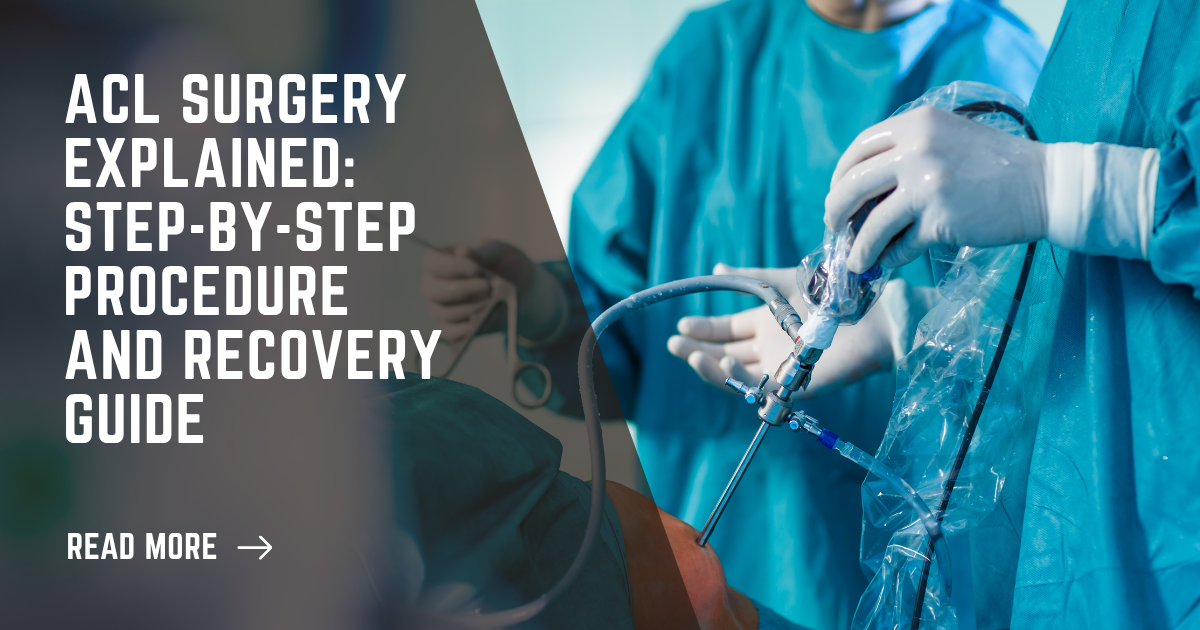
The procedure is usually performed arthroscopically, also known as arthroscopic knee surgery, which means the surgeon uses a camera and specialised instruments through small incisions around the knee.
Why Arthroscopy Is Commonly Used
Arthroscopy allows the surgeon to see inside the knee joint without making a large incision. It also helps assess other structures inside the joint, such as the meniscus and cartilage, because ACL injuries are not always isolated.
Patients often feel reassured by the fact that the incisions are small. However, it is important not to confuse small cuts on the skin with a minor recovery. The surgical wounds may be small, but rehabilitation still plays a major role in the final outcome.
Step by Step: What Happens During ACL Surgery?
Although exact techniques may vary, the general sequence of ACL reconstruction is usually as follows.
1. Anaesthesia and Preparation
The patient is prepared for surgery under appropriate anaesthesia. The knee is cleaned and positioned for the procedure.
2. Arthroscopic Entry
Small incisions are made around the knee. A camera is inserted so the inside of the joint can be visualised clearly on a screen.
3. Assessment of the Knee
The ACL tear is confirmed, and the surgeon checks for associated injuries such as meniscus tears or cartilage damage.
4. Graft Preparation
If the graft is being taken from the patient’s own tissue, it is prepared carefully to the required size and configuration.
5. Preparation for Reconstruction
The damaged ACL tissue is cleared as needed to make way for the new graft.
6. Tunnel Creation
Small tunnels are created in the thigh bone and shin bone so the graft can be positioned in a way that restores the function of the natural ACL as closely as possible.
7. Graft Placement
The graft is passed through the prepared tunnels and positioned appropriately.
8. Fixation
The graft is secured using fixation devices so it remains stable while healing begins.
9. Final Stability Check
The surgeon checks graft position and knee stability before closing the incisions.
In many cases, the operation takes around one to two hours, depending on whether additional procedures are needed.
What Happens Immediately After Surgery?
Recovery begins as soon as the procedure is over. The first few days focus on protecting the knee, reducing swelling, managing discomfort, and starting early controlled movement.
The early phase usually includes:
-
pain management
-
swelling control
-
wound care
-
basic movement exercises
-
guided weight-bearing as advised
-
muscle activation, especially for the thigh muscles
Depending on the case, walking with support may begin early. Some patients may also be advised to use a brace, particularly if there are associated injuries or specific surgical considerations.
The goal in the beginning is not speed. It is control.
ACL Recovery Timeline
Recovery after ACL surgery happens in phases rather than all at once.
First 2 Weeks
The priorities are reducing swelling, managing pain, regaining basic knee movement, activating the quadriceps muscle, and beginning supported walking if advised.
Weeks 2 to 6
The focus shifts to improving range of motion, normalising walking pattern, continuing swelling control, and building early strength.
6 Weeks to 3 Months
This phase focuses on rebuilding strength, improving balance, restoring movement control, and gradually progressing daily activities.
3 to 6 Months
Rehabilitation becomes more advanced, with stronger conditioning, better single-leg control, and functional movement training.
6 to 9 Months and Beyond
Return to sports is assessed based on strength, movement quality, knee control, and overall readiness. Recovery speed varies from person to person, so progression should be guided by function rather than impatience.
Why Rehabilitation Matters So Much
ACL reconstruction restores structural stability, but surgery alone does not rebuild strength, coordination, or confidence. That is why rehabilitation is such a central part of treatment.
A structured physiotherapy programme helps:
-
rebuild thigh and hip strength
-
restore knee movement
-
improve balance and coordination
-
reduce the risk of re-injury
-
retrain landing, turning, and movement mechanics
-
prepare for safe return to activity
One of the most common mistakes after surgery is assuming that less pain means full recovery. Pain relief and functional readiness are not the same thing.
Common Mistakes to Avoid After ACL Surgery
Returning Too Early
Trying to run, train, or play sports before the knee is ready can delay recovery and increase the risk of further problems.
Skipping Rehabilitation
Physiotherapy is not optional. Irregular rehab often slows progress and affects long-term results.
Ignoring Swelling
A knee that repeatedly swells after activity may be telling you that the progression is too fast.
Comparing Yourself to Others
Every recovery is individual. Comparing timelines often creates unnecessary pressure.
Focusing Only on Time
A patient is not automatically ready for sports just because a certain number of months has passed. Strength, control, and clinical assessment matter more.
When Can You Return to Sports?
This depends on knee stability, strength, movement control, confidence, and functional assessment. The goal is not just to return quickly. It is to return safely and well.
For some patients, return to sport may happen earlier than for others, but the decision should always be based on proper evaluation rather than a fixed calendar date.
What Are the Possible Risks?
ACL surgery is commonly performed and generally considered safe, but like any surgery, it does carry potential risks. These may include infection, stiffness, swelling, graft-related issues, or persistent instability in some cases.
These are not the usual outcome, but patients should still understand that surgery is only one part of the process. Good rehabilitation and careful follow-up remain essential.
Long-Term Outlook After ACL Reconstruction
With the right treatment pathway, many patients return to active life after ACL reconstruction. Some return to recreational exercise, some to more demanding sports, and many to daily movement with much better confidence than before surgery.
Long-term results depend on the quality of rehabilitation, restoration of strength, gradual return to activity, management of associated injuries, and consistency over time.
The surgery happens on one day. Recovery continues for months. Respecting both parts of that journey usually leads to better outcomes.
When Should You See an Orthopedic Doctor?
You should seek evaluation if you have:
-
a twisting knee injury followed by swelling
-
a popping sensation in the knee
-
repeated giving way of the knee
-
difficulty returning to activity
-
pain and instability during pivoting movement
-
persistent swelling after a sports injury
Early evaluation helps determine whether the knee needs imaging, rehabilitation, bracing, or surgical discussion.
Consult Dr. Chintan Patel for ACL Injury and Treatment
If you have had a knee injury, instability episode, or suspected ACL tear, proper evaluation is the first step in deciding the right treatment plan.
Dr. Chintan Patel specialises in sports injuries, ligament reconstruction, and joint preservation procedures. His approach focuses on accurate diagnosis, clear patient education, non-surgical treatment where appropriate, and surgical management when needed. He operates from his clinic in Mumbai as well as other prominent locations.
Consult an experienced ACL reconstruction surgeon in Ghatkopar for personalised treatment. With the right treatment plan and a structured rehabilitation journey, many patients are able to return to activity with better knee stability, stronger function, and greater confidence.
If you are considering ACL surgery in Mumbai, early diagnosis and proper care can significantly improve outcomes.
Frequently Asked Questions (FAQs)
What is the recovery time after ACL surgery?
ACL recovery time typically ranges from 6 to 9 months depending on rehabilitation and individual progress.
Is ACL surgery necessary for all ACL tears?
No, ACL tear treatment depends on knee stability, lifestyle, and activity level.
What is arthroscopic knee surgery?
Arthroscopic knee surgery is a minimally invasive procedure used to reconstruct the ACL using small incisions and a camera.
When can I return to sports after ACL surgery?
Most patients can return to sports after 6-9 months, depending on strength, stability, and recovery progress.
Who should I consult for an ACL injury?
You should consult an ACL reconstruction surgeon in Ghatkopar or a sports injury specialist in Mumbai for proper diagnosis and treatment.