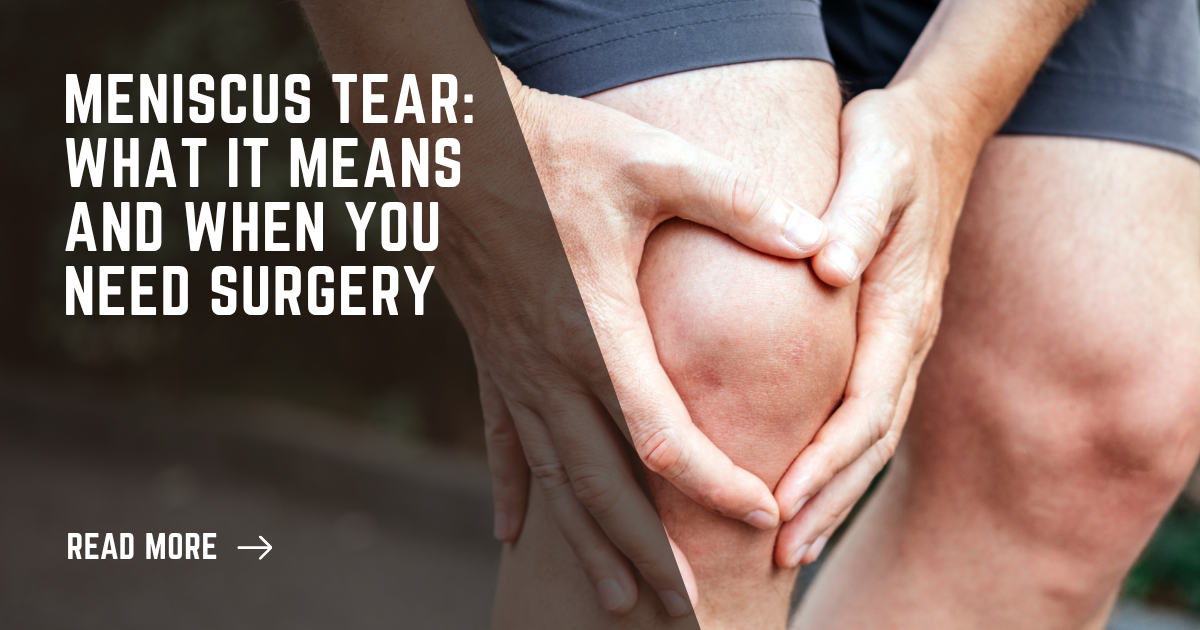
Knee pain is one of the most common reasons people begin to limit their movement. It rarely appears suddenly without context. In many cases, it develops gradually through everyday activities such as walking, climbing stairs, or getting up after sitting for long periods. Initially, the discomfort may seem minor. It may come and go, or appear only during certain movements. Because of this, it is often ignored.
Over time, however, the same symptoms can begin to affect confidence in movement. Simple activities may feel less comfortable, and there may be a growing awareness that the knee is not functioning as smoothly as before. One of the common causes behind this pattern is a meniscus tear.
The term itself is not always familiar to patients at first. Most people describe their symptoms more generally as knee pain, stiffness, or a sensation of something catching inside the joint. Understanding what the meniscus does, how it gets injured, and when treatment becomes necessary helps in recognising the problem early and taking appropriate steps.
What Is the Meniscus and Why Is It Important
The knee joint is made up of several structures that work together to allow smooth and stable movement. Among these are two small, curved structures known as the menisci. They are positioned between the thigh bone and the shin bone and act as natural cushions within the joint.
Their role is to distribute weight, absorb impact, and support controlled movement. Every time the knee bends, straightens, or bears weight, the meniscus helps manage the forces passing through the joint. This makes it essential for everyday activities as well as more demanding movements.
Because the meniscus is involved in nearly all weight-bearing activity, it is exposed to repeated stress over time. This makes it vulnerable to injury, either through a sudden movement or gradual wear.
How a Meniscus Tear Happens
A meniscus tear can occur in different ways, and the pattern often depends on activity level and age.
In active individuals, the injury is commonly associated with a twisting movement. This may happen during sports, exercise, or even a quick change in direction during routine activity. When the foot remains planted and the knee rotates, it can place stress on the meniscus. Even if the movement does not seem severe, it can lead to a tear.
In other situations, particularly in adults, the tear may develop gradually. There may not be a single identifiable moment of injury. Instead, repeated movements such as squatting, climbing stairs, or standing for extended periods can contribute over time. As the meniscus becomes less resilient, it may become more sensitive to routine stress.
This is why some people experience symptoms without recalling a specific incident. The knee pain may appear suddenly, but the underlying process may have developed over a longer period.
Symptoms That Should Not Be Ignored
The symptoms of a meniscus tear are often subtle in the early stages. Many individuals continue their daily routine before realising that the discomfort is not improving.
Pain is usually felt along one side of the knee, either on the inner or outer part. It may not be constant and often becomes noticeable during specific movements such as bending, squatting, or turning.
Swelling may develop within a short period after the onset of symptoms or build gradually over time. Some individuals notice a clicking or catching sensation inside the joint. Others feel that the knee does not move smoothly or cannot be fully straightened.
In certain cases, the knee may feel as though it gets temporarily stuck during movement. This is commonly described as locking. These patterns are often grouped under knee cartilage injury symptoms, which can sometimes lead to delays in recognising the exact cause.
Can a Meniscus Tear Heal Without Surgery
Not every meniscus tear requires surgery. In many cases, especially when symptoms are mild, a non-surgical approach may be considered.
This can include activity modification, structured exercises, and gradual strengthening. These measures aim to reduce strain on the knee and improve overall function. Over time, some individuals notice improvement in comfort and movement.
However, not all tears respond in the same way. Some continue to cause pain, catching, or restriction in movement despite these efforts. In such situations, the knee may not return to comfortable function without further intervention.
The decision to proceed with treatment is based on how the knee feels during daily activity and how much the symptoms affect routine movement. It is not based only on imaging findings.
When Surgery Is Considered
Surgery is usually considered when symptoms persist and begin to interfere with daily life.
This may include situations where pain does not improve, movement feels restricted, or the knee continues to catch or lock. Activities such as walking, climbing stairs, or getting up from a seated position may become uncomfortable.
At this stage, the focus shifts toward improving joint movement and restoring comfort in daily activities. The aim is to support better function rather than simply addressing the tear itself.
What Arthroscopic Surgery Involves
When surgery is required, it is commonly performed using arthroscopy. This is a minimally invasive technique that involves small incisions and the use of a camera to visualise the inside of the knee.
Specialised instruments are used to address the affected area while minimising disruption to surrounding tissues. Because of this approach, the procedure is often associated with a smoother recovery process compared to traditional open surgery.
Many patients searching for information about meniscus tear treatment also look for details on arthroscopic knee surgery recovery, as understanding the recovery process helps set realistic expectations.
Recovery After Arthroscopic Knee Surgery
Recovery after arthroscopic surgery is gradual and structured. Movement is usually introduced early, but always in a controlled and guided manner.
In many cases, patients are able to stand and take a few steps with support on the same day, depending on comfort levels. This early movement helps the joint begin adapting and supports circulation.
Over the following weeks, the focus shifts toward improving knee mobility, rebuilding strength, and restoring confidence in movement. Daily activities are reintroduced gradually, based on comfort and progress.
Recovery does not happen instantly. It is a steady process that requires consistency and patience.
What Influences Recovery
Recovery varies from person to person. Several factors can influence how the knee responds over time.
These include the nature of the tear, activity levels, overall health, and how consistently rehabilitation exercises are followed. A gradual and structured approach generally supports better recovery than rushing through the process.
Improvement is often seen as a combination of reduced discomfort, better movement, and increased confidence during daily activities.
Common Mistakes That Can Delay Recovery
Certain patterns can make recovery more challenging. One common issue is ignoring early symptoms and continuing activities that strain the knee. This can prolong discomfort and delay improvement.
Another common pattern is returning too quickly to high-impact or demanding activities once the pain begins to reduce. While improvement in symptoms is encouraging, it does not always mean the knee has fully regained strength and control.
Stopping exercises too early is another factor that can affect recovery. Strength and stability take time to rebuild, and consistency plays an important role.
A balanced approach that combines gradual progression with regular movement is usually more effective.
When You Should Seek Medical Advice
Persistent knee symptoms should not be ignored. An evaluation can help identify the cause and guide appropriate management.
It is advisable to seek medical advice if:
-
Pain continues for several days
-
Swelling keeps returning
-
The knee feels unstable or restricted
-
There is a catching or locking sensation
-
Daily activities are affected
Early assessment allows for better understanding of the condition and helps in planning the next steps before symptoms become more limiting.
Long-Term Outlook
With the right approach, many individuals are able to return to comfortable daily movement. The goal is not only to reduce pain but also to improve how the knee functions during routine activities.
Long-term knee health depends on consistent care, gradual strengthening, and attention to movement patterns. Small adjustments in daily habits, combined with appropriate guidance, can support better joint function over time.
Consult Dr. Chintan Patel for Knee Pain and Prevention
If you are experiencing knee discomfort, stiffness, or symptoms that are not improving, a proper evaluation can help identify the cause and guide the next steps. Addressing knee pain early can support better movement and reduce unnecessary strain over time.
Dr. Chintan Patel is a robotic orthopedic surgeon specialising in knee and hip replacement. His approach focuses on clear patient understanding, careful evaluation, and personalised treatment planning based on individual needs.
He provides care for a wide range of knee conditions, including meniscus-related problems, with an emphasis on improving function and supporting long-term joint health. Consultations are available at his clinic in Ghatkopar Mumbai as well as other prominent locations.
With the right guidance and consistent care, many people are able to improve knee function and continue their daily activities with greater ease.
Frequently Asked Questions (FAQs):
1. What are the early signs of a meniscus tear?
Pain on one side of the knee, swelling, or a catching sensation during movement are common early signs.
2. Can I continue walking if I have a meniscus tear?
Many people are able to walk, but certain movements like squatting or turning may feel uncomfortable.
3. Is surgery always required for meniscus tear treatment?
No. Some cases improve with non-surgical care depending on symptoms and how the knee functions.
4. How long does arthroscopic knee surgery recovery take?
Recovery is gradual, and most people return to routine activities over a few weeks with proper guidance.
5. Where can I consult for meniscus tear treatment in Ghatkopar?
If knee pain or knee cartilage injury symptoms are affecting your daily life, consulting an orthopedic specialist in Ghatkopar can help you understand the cause and the next steps.
6. What happens if a meniscus tear is not treated?
Symptoms such as pain, stiffness, or restricted movement may continue and affect daily activities over time.