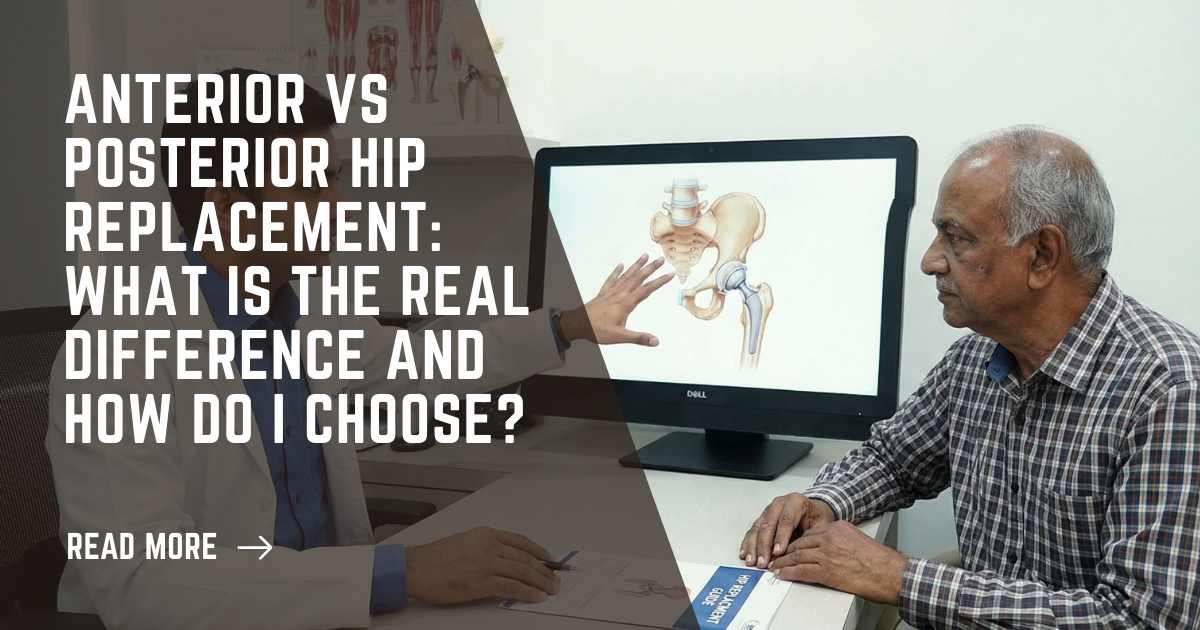
In recent years, patient awareness around hip replacement surgery has increased significantly. Earlier, the most common question was whether surgery was required. Today, many patients ask a more specific question: which surgical approach is better, anterior or posterior?
This shift reflects better access to information, but it has also created confusion. Online sources often present these approaches as competing options, suggesting that one is superior to the other.
In reality, the decision is more nuanced. The most suitable approach depends on individual anatomy, the underlying condition, and the surgeon’s experience. It is not a one-size-fits-all choice.
This article explains the differences between anterior and posterior hip replacement, how each approach works, and what factors matter when deciding the right option.
What Is a Total Hip Replacement?
The hip is a ball-and-socket joint formed by the femoral head and the acetabulum. In a healthy joint, cartilage allows smooth and pain-free movement.
In conditions such as osteoarthritis or avascular necrosis, this cartilage wears down or the bone is affected. This leads to pain, stiffness, and reduced mobility.
Total hip replacement involves removing the damaged joint surfaces and replacing them with artificial components. The goal is to restore smooth movement and reduce pain.
The surgical approach refers only to how the joint is accessed during surgery. It does not change what is replaced.
The Posterior Approach
How It Works
The posterior approach involves accessing the hip joint from the back. This provides clear visibility of the joint, allowing accurate placement of components.
Why It Is Commonly Used
This approach has been used for many years and is supported by long-term outcomes. It allows flexibility in handling a wide range of patient anatomies and complex cases.
Recovery Considerations
Patients are advised to follow certain movement precautions in the early recovery phase to support healing. These are temporary and gradually reduced as recovery progresses.
The Anterior Approach
How It Works
The anterior approach accesses the joint from the front, using natural intervals between muscles rather than detaching them.
Potential Advantages
In selected patients, early recovery may feel more comfortable, and some initial restrictions may be fewer.
Important Considerations
This approach requires specific surgical expertise and may not be suitable for all patients. Proper patient selection is essential.
Anterior vs Posterior: What Actually Differs
Differences include:
-
Location of the incision
-
Surgical pathway to the joint
-
Early recovery precautions
What remains the same:
-
The implant used
-
The goal of surgery
-
Long-term functional outcomes in most cases
The most important factor is not the approach alone, but how well the procedure is performed and how appropriate the approach is for the individual patient.
Role of Robotic Hip Replacement
Robotic-assisted surgery is a technology used to improve accuracy in implant positioning. It is not a separate surgical approach.
It can be used with both anterior and posterior techniques. By improving precision, it supports better alignment and may contribute to improved long-term outcomes.
How the Surgical Approach Is Decided
Selecting the appropriate approach involves evaluating several factors:
-
Age and activity level
-
Body structure and muscle profile
-
Bone quality
-
Severity of joint damage
-
Previous surgeries
In some cases, both approaches may be suitable. In others, one approach may offer better safety and control.
The decision is individualised and based on achieving the most reliable outcome.
When Is Hip Replacement Recommended?
Hip replacement is considered when:
-
Pain significantly affects daily activities
-
Walking distance is reduced
-
Sleep is disturbed
-
Conservative treatment no longer provides relief
Non-surgical options are always explored first. Surgery is recommended when it offers the most meaningful improvement in quality of life.
Recovery After Hip Replacement
Recovery follows a structured process:
-
Early phase focuses on mobility and healing
-
Intermediate phase focuses on strengthening and physiotherapy
-
Later phase focuses on functional recovery
Most patients gradually return to routine activities over a few months.
Rehabilitation plays a key role in achieving a successful outcome, regardless of the approach used.
Frequently Asked Questions
Is anterior hip replacement better than posterior?
No single approach is universally better. Both provide good outcomes when used appropriately.
Which approach has a lower risk of dislocation?
With modern surgical techniques, both approaches have low complication rates.
Will precautions be required after surgery?
Yes. The type and duration of precautions vary depending on the approach and individual recovery.
Can robotic surgery be used with both approaches?
Yes. Robotic assistance can be used with both anterior and posterior techniques.
How is the right approach chosen?
The decision is based on clinical evaluation, imaging, and individual patient factors.
Is age a limiting factor?
Overall health is more important than age alone.
How long does a hip replacement last?
Modern implants are designed to last many years, depending on factors such as activity level and implant positioning.
Consult Dr. Chintan Patel for Hip Replacement
If you are considering hip replacement or want clarity on the most suitable surgical approach, a detailed evaluation is the first step.
Dr. Chintan Patel specialises in hip and knee replacement, robotic joint replacement surgery, and sports orthopedics. He operates from his orthopedic clinic in Ghatkopar, Mumbai, as well as other prominent locations, providing comprehensive orthopedic care with a focus on precision, safety, and long-term outcomes.
Choosing between anterior and posterior hip replacement is not about selecting a trend. It is about choosing the most appropriate approach for your specific condition and ensuring the best possible outcome.