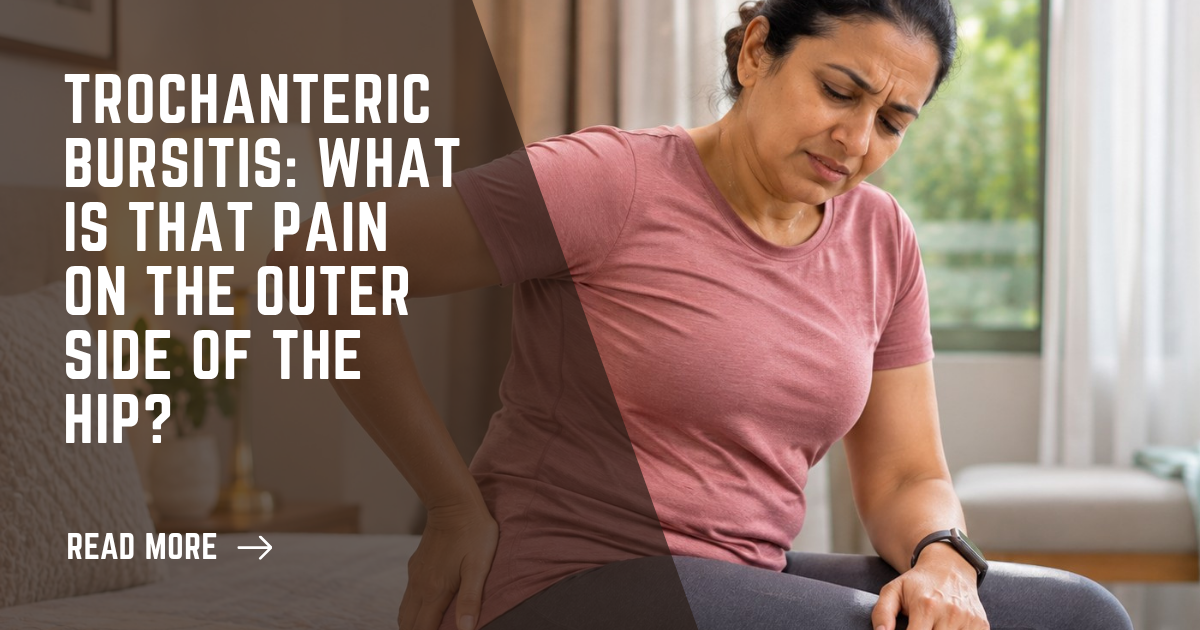
Hip pain does not always originate from inside the hip joint. Sometimes, the discomfort is felt along the outer side of the hip, particularly when lying on that side at night, walking for longer distances or climbing stairs.
For some people, the area becomes so sensitive that even pressure from sleeping on the affected side can disturb their rest. Others notice a persistent ache that makes everyday movements uncomfortable.
One possible explanation is a condition commonly called trochanteric bursitis. However, outer hip pain can involve more than just an inflamed bursa. The tendons and other soft tissues surrounding the hip may also contribute to the discomfort. These conditions are often discussed under the broader term greater trochanteric pain syndrome (GTPS).
What Is Trochanteric Bursitis?
The greater trochanter is a bony prominence at the upper end of the thigh bone (femur). It can be felt along the outer side of the hip. Bursae are small, fluid-filled sacs that help reduce friction between bones, tendons and other soft tissues. When a bursa around the greater trochanter becomes irritated or inflamed, this is called trochanteric bursitis.
Tendons also attach around the greater trochanter, and changes or irritation affecting these tendons can produce pain on the outer side of the hip as well.
Trochanteric Bursitis vs Greater Trochanteric Pain Syndrome
Although the terms are sometimes used interchangeably, they do not mean exactly the same thing. Trochanteric bursitis specifically refers to irritation or inflammation of a bursa.
GTPS is a broader clinical term describing pain around the greater trochanter. It may involve gluteal tendinopathy (changes affecting the tendons), tendon tears, bursitis or a combination of these conditions. This distinction matters because management often needs to address how the muscles and tendons around the hip respond to everyday loads, rather than focusing only on inflammation.
What Does Outer Hip Pain Feel Like?
GTPS commonly causes discomfort around the bony prominence on the outer side of the hip. The pain may remain localised or extend down the outside of the thigh. Some people describe a dull ache, while others experience sharper discomfort during certain movements.
Symptoms may become noticeable when:
• Lying on the affected side
• Walking longer distances than usual
• Climbing stairs
• Standing on one leg
• Getting up from a chair
The outer hip may also feel tender when touched or pressed. However, these symptoms are not unique to GTPS. Other hip conditions, lower-back problems and certain nerve-related conditions can produce overlapping pain patterns.
How Is This Different From Hip Joint Pain?
Conditions affecting structures within the hip joint, such as hip osteoarthritis, may cause discomfort in the groin, front of the thigh or occasionally around the knee, and may be associated with stiffness. GTPS more often produces pain around the outer hip, particularly when the area is compressed or the hip muscles are loaded.
However, these patterns are not absolute. A person may have GTPS alongside a hip joint condition, and pain location alone cannot establish the diagnosis. A clinical examination helps assess whether symptoms are more likely to involve the hip joint, surrounding tendons or another structure.
Who Can Develop Greater Trochanteric Pain Syndrome?
GTPS can affect adults across different age groups, although it is more frequently reported in middle-aged and older adults and is more common in women.
Changes in the way the hip is loaded may play a role. For example, a sudden increase in running distance, hill walking or exercise intensity may place greater demands on the tendons than they are accustomed to managing. Some people develop symptoms after an injury or after a period of reduced activity followed by a rapid return to exercise, and some develop symptoms gradually without a clear trigger.
Regular walking, cycling or exercise should not automatically be considered harmful or a cause of GTPS. Physical activity is generally beneficial. The important consideration is whether the demands placed on the hip are appropriate for the individual's current strength and capacity. Likewise, an activity or sleeping position that aggravates pain does not necessarily mean that it originally caused the condition.
How Is GTPS Diagnosed?
Assessment usually begins with a detailed medical history and physical examination. A clinician may ask where the discomfort is felt, how it began, which activities aggravate it and whether it affects walking, exercise or sleep. The examination may include checking tenderness around the greater trochanter and assessing hip movement and strength. The lower back and hip joint may also be assessed, because pain from these areas can sometimes resemble GTPS.
Imaging is not always necessary, as GTPS is often diagnosed clinically. It may be considered when the diagnosis is uncertain, symptoms remain persistent despite appropriate management or another condition is suspected. Imaging findings must be interpreted alongside the clinical examination, because tendon changes or fluid around a bursa can sometimes be visible in people who do not experience corresponding symptoms.
What Are the Treatment Options for Trochanteric Bursitis and GTPS?
Most people with GTPS are initially managed without surgery. Treatment depends on the structures involved, symptom severity, physical capacity and the activities the person wants to return to.
1. Physiotherapy and Progressive Strengthening
Exercise-based rehabilitation is an important part of managing GTPS, particularly when tendon involvement is suspected. A physiotherapy programme may begin with exercises that are manageable at the person's current level of discomfort and progress gradually towards more demanding movements. The progression needs to be individualised. Some stretching positions, particularly those that bring the leg across the body and increase pressure over the greater trochanter, may aggravate symptoms, so stretching is not automatically beneficial for everyone.
2. Activity and Sleeping Position Adjustments
Small changes in everyday habits may help reduce irritation while rehabilitation progresses. Avoiding direct pressure on the affected hip while sleeping may improve comfort, and sleeping on the opposite side with a pillow between the knees may help some people. Temporarily adjusting activities that repeatedly provoke substantial pain, such as walking distance or hill climbing, can also be useful before gradually rebuilding tolerance. The aim is to support recovery while maintaining activity, rather than encouraging prolonged inactivity.
3. Medication and Injections
Pain-relieving medication may be considered when symptoms interfere with sleep or daily activities, although it does not necessarily correct underlying tendon-related problems and is not appropriate for everyone. Corticosteroid injections may be considered in selected cases and can provide short-term relief for some patients, but symptoms may return, and repeated injections require caution. Rehabilitation and load management remain important in either case.
4. Is Surgery Ever Needed?
Surgery is uncommon for GTPS. It may be considered in carefully selected patients with persistent symptoms despite appropriate non-surgical management, particularly when significant gluteal tendon tears are identified. It is not routinely indicated for outer hip pain or an imaging finding of bursitis alone.
When Should Outer Hip Pain Be Assessed?
Outer hip discomfort that is mild and improving may settle with appropriate activity adjustments. However, medical assessment may be appropriate when pain is persistent, worsening, repeatedly disturbing sleep or limiting walking and daily activities.
Warning Signs That Need Urgent Medical Attention
Certain symptoms should not be assumed to be bursitis or tendon-related pain. Seek urgent medical evaluation if there is:
• Inability to stand or bear weight after a fall or injury
• Severe hip pain following significant trauma
• Fever accompanied by a hot, markedly painful or swollen hip
• Sudden, severe hip pain with substantial difficulty moving the leg
These symptoms may indicate an injury, infection or another condition requiring prompt investigation.
Frequently Asked Questions
1. Is trochanteric bursitis the same as hip arthritis?
No. Trochanteric bursitis involves a bursa near the greater trochanter, while hip osteoarthritis involves changes within the hip joint itself. The two can overlap or occur together.
2. Can outer hip pain improve without injections or surgery?
Yes. Many people with GTPS improve through activity adjustments and progressive strengthening, although the response varies. Injections and surgery are not necessary for everyone.
3. Should I completely stop walking if I have GTPS?
Not necessarily. Walking can often be continued at a level that the hip tolerates. If longer distances consistently aggravate symptoms, temporarily reducing the distance may help, and walking can be increased gradually as tolerance improves.
Understanding Outer Hip Pain
Pain on the outer side of the hip can affect sleep, walking and everyday comfort, but it does not always indicate a problem inside the hip joint. For many people, appropriate strengthening, gradual activity progression and practical adjustments can help manage symptoms and improve function.
About the doctor:
This article is general health information and is not a substitute for medical advice. Please consult a registered medical practitioner about your own condition.
Dr. Chintan Patel, Orthopaedic Surgeon
Sanjeevani Healthcare, Ghatkopar West, Mumbai.