When someone is preparing for knee replacement surgery, most of their questions are usually about pain, recovery, and getting back to daily life. But there is another question that comes up just as often, usually once the decision to go ahead with surgery has already been made: what kind of implant will actually be used?
It's a fair question. The implant is, after all, the part that will support movement for many years to come. Yet for most patients, the topic feels confusing, terms like "cemented," "uncemented," "mobile-bearing," or "Indian versus imported" are thrown around without much explanation. This blog is meant to make that conversation simpler, so that if your orthopaedic surgeon discusses implant options with you, you already have a general understanding of what is being talked about.
Why Implant Choice Even Comes Up
A knee replacement implant is designed to replace the damaged surfaces of the knee joint and allow it to move smoothly again. While the overall goal of every implant is the same restoring function and reducing pain there are different designs and fixation methods available, and the most suitable option can vary depending on a person's age, activity level, bone quality, and overall health.
This is why implant selection is rarely a one-size-fits-all decision. It is usually made jointly between the patient and the surgeon, based on an individual assessment rather than a fixed rule.
The Basic Parts of a Knee Implant
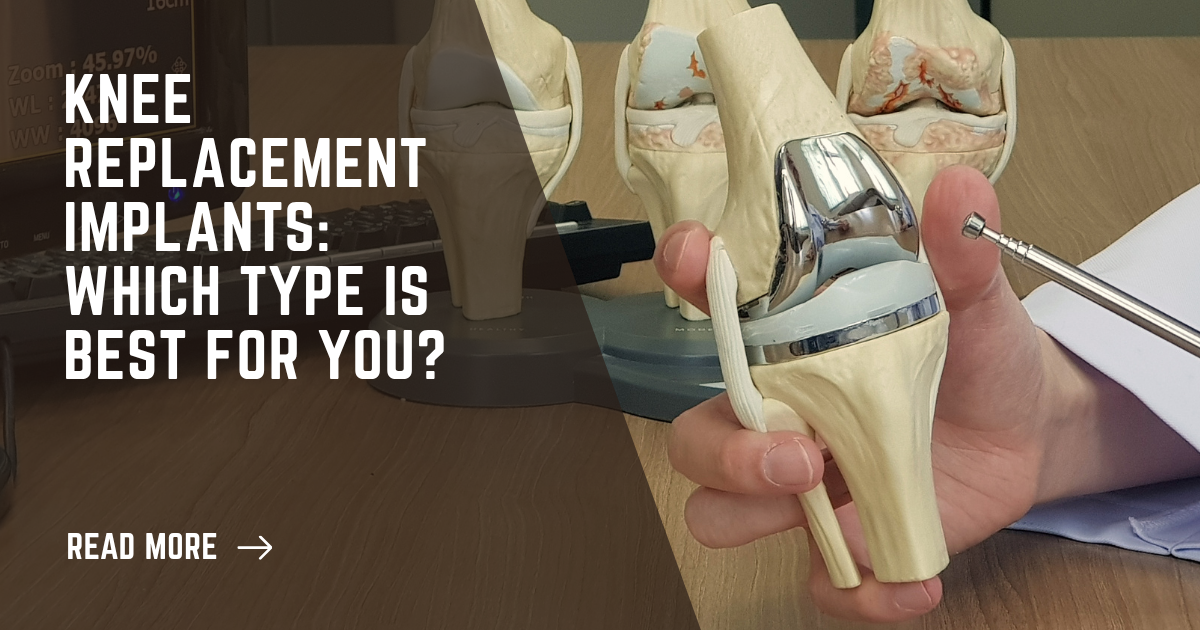
To understand the different types of implants, it helps to first understand what a knee implant is generally made of. Most knee replacement implants consist of a few components that work together to recreate the movement of a natural knee joint:
-
A component that resurfaces the lower end of the thigh bone
-
A component that resurfaces the top of the shin bone
-
A spacer that sits between them and allows smooth movement
-
In many cases, a component that resurfaces the back of the kneecap
The materials and design of these components can differ between implant systems, which is part of what leads to the different categories patients often hear about.
Cemented vs Uncemented Knee Replacement
One of the most common questions patients have is about how the implant is actually fixed to the bone. Broadly speaking, there are two approaches.
Cemented fixation uses a special medical-grade bone cement to hold the implant firmly in place immediately after surgery. This method has been used for a long time and is considered a well-established option, particularly suitable for patients with softer or older bones.
Uncemented (or "press-fit") fixation relies on an implant surface that is designed to allow bone to gradually grow onto it over time, creating a natural bond. This approach may be considered for patients with good bone quality, and is more commonly discussed in younger, more active patients though the decision always depends on individual bone assessment rather than age alone.
Some surgeons also use a hybrid approach, combining both methods for different parts of the implant. Your orthopaedic surgeon will determine which method is appropriate for you based on your bone density, activity levels, and overall health, usually assessed through pre-surgical imaging and evaluation.
Fixed-Bearing vs Mobile-Bearing Implants
Another distinction patients often come across is between fixed-bearing and mobile-bearing implants. This refers to how the plastic spacer between the two main components behaves during movement.
In a fixed-bearing implant, the spacer stays firmly attached to the lower component and does not move independently. This design has a long track record and is widely used across the world.
In a mobile-bearing implant, the spacer is designed to rotate slightly during movement, aiming to more closely mimic the natural motion of the knee. Some surgeons feel this may be beneficial for certain patients, particularly those who are more active, though opinions among specialists can vary, and this is generally an area of ongoing clinical discussion.
Neither design is universally considered superior the appropriate choice depends on a patient's anatomy, lifestyle, and the surgeon's clinical judgment and experience with a particular system.
Material Considerations
Most modern knee implants are made using a combination of metal alloys (such as cobalt-chromium or titanium-based alloys) for the components that resurface the bone, and a durable medical-grade plastic (polyethylene) for the spacer in between. In some implant systems, ceramic-coated components are also available, and may be discussed for patients with known sensitivities to certain metals.
The specific combination of materials used can vary between implant manufacturers, and your surgeon will be able to explain the materials involved in the specific system recommended for you.
Indian-Manufactured vs Imported Implants
This is a question that comes up frequently in consultations, especially given the range of options now available in India. Over the years, implant manufacturing in India has grown significantly, and several Indian companies now produce implants that meet recognised international quality and safety standards.
At the same time, many imported implant systems, often from established international manufacturers, continue to be widely used across hospitals in India, including in Mumbai.
Rather than one category being categorically better than the other, the more relevant factors tend to be:
-
Whether the implant system has an established clinical track record
-
Whether it suits the patient's specific anatomical needs
-
The surgeon's experience and comfort with that particular system
-
Long-term data and monitoring associated with the implant
This is a conversation worth having directly with your orthopaedic surgeon, who can walk you through the specific options available and the reasoning behind a recommendation, based on your individual case.
Does the "Best" Implant Really Exist?
Patients often search for the single "best" implant, hoping there is one universal answer. In reality, orthopaedic surgeons generally look at implant selection as a matter of matching the right implant to the right patient, rather than ranking implants on a fixed scale.
Several things are typically taken into account, including:
-
The patient's age and activity level
-
Bone quality and any pre-existing joint deformity
-
Any known allergies or sensitivities
-
The surgical technique being used (including whether robotic assistance is involved)
-
The surgeon's experience with a particular implant system
Because of this, two patients undergoing knee replacement in the same hospital, even around the same time, may end up with different implants, and both decisions can be entirely appropriate for their respective situations.
What Patients Can Reasonably Ask Their Surgeon
If you are preparing for knee replacement surgery, it is completely reasonable to ask your surgeon about the implant being used. Some questions patients often find helpful include:
-
What type of fixation is being recommended for me, and why?
-
Is this a fixed-bearing or mobile-bearing design?
-
What materials are used in this implant?
-
Is this an Indian-manufactured or imported system, and what is the reasoning behind this choice?
A good consultation should leave you feeling informed, not overwhelmed, and your surgeon should be able to explain these choices in a way that makes sense for your specific situation.
Recovery Is About More Than the Implant
It's worth remembering that the long-term success of a knee replacement depends not only on the implant itself, but also on several other factors including the precision of the surgical technique, how well the joint is aligned, and how consistently a patient follows post-operative guidance and rehabilitation. The implant is one important piece of a much larger picture.
When Should You See an Orthopaedic Doctor?
If knee pain has reached a point where it is affecting your ability to walk, climb stairs, or carry out daily activities, and non-surgical options have not provided lasting relief, it may be time to discuss your situation with an orthopaedic surgeon. During this consultation, questions about implant types, if relevant to your case, can be addressed in detail.
Consult Dr. Chintan Patel for Knee and Hip Care
If knee or hip pain is affecting your daily activities, a professional assessment can help identify the cause and discuss the most appropriate treatment options.
Dr. Chintan Patel is a robotic orthopaedic surgeon specialising in knee and hip replacement. He provides comprehensive orthopaedic care focused on accurate diagnosis, conservative treatment where appropriate, and advanced surgical care when required. He consults at Sanjeevani Healthcare in Ghatkopar, Mumbai, as well as other prominent locations.
An individual consultation can help you better understand your condition and the treatment options available.
Frequently Asked Questions
Is a cemented or uncemented implant better?
Neither option is universally better. The choice depends on factors such as bone quality and overall health, and your orthopaedic surgeon will guide you based on an individual assessment.
Are imported knee implants better than Indian-made ones?
Not necessarily. Many Indian-manufactured implants meet recognised quality standards, and the more relevant factors are the implant's track record and how well it suits your specific needs, rather than its country of origin.
Will I be told in advance which implant will be used?
In most cases, yes. Your surgeon will typically discuss the recommended implant and fixation method with you before surgery, along with the reasoning behind the choice.
Does implant type affect how long it lasts?
Implant longevity can be influenced by several factors, including implant type, surgical technique, and how well post-operative guidance is followed. Your surgeon can give you a better understanding based on your specific case.
Can I request a specific implant brand?
This is a conversation worth having with your surgeon. They can explain which systems they have experience with and which may be most suitable for your particular situation.